
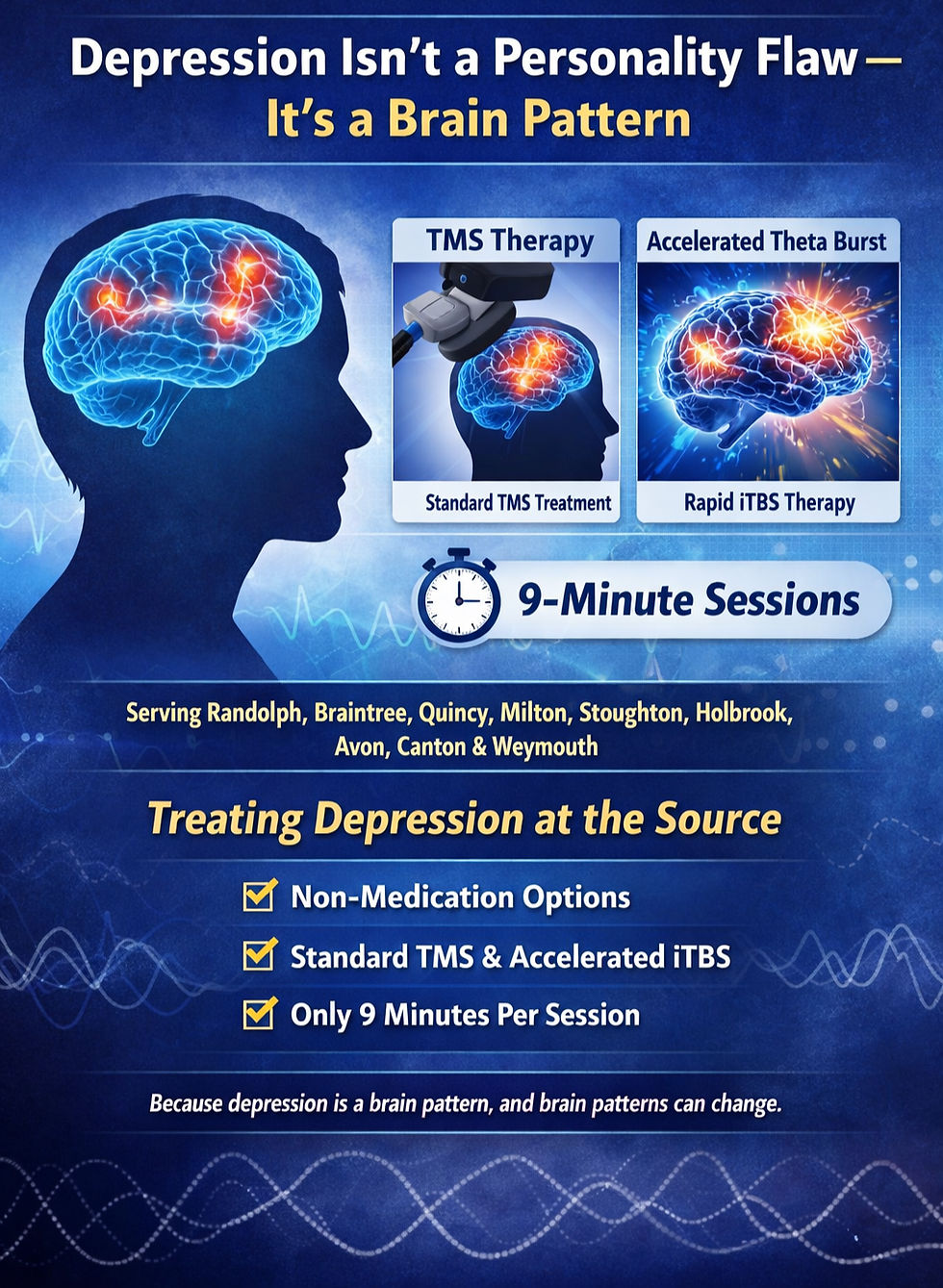
Depression Isn’t a Personality Flaw — It’s a Brain Pattern

Southeastern Psychiatric Associates TMS Center in Randolph provides advanced, evidence-based treatment for depression using Transcranial Magnetic Stimulation (TMS). At SEPA TMS, our mission is rooted in both science and compassion: Depression is not a personality flaw.It is not laziness.It is not a lack of willpower.
Depression is a brain-based condition involving identifiable patterns of neural activity — and those patterns can change.For individuals living in Randolph and nearby communities such as Braintree, Quincy, Milton, Stoughton, Holbrook, Avon, Canton, and Weymouth, understanding this shift — from shame to neuroscience — can be life-changing.
What’s Actually Happening in the Brain During Depression?
When people search online for:
“Why am I always exhausted?”
“Why can’t I feel joy anymore?”
“Is depression just part of my personality?”
They are often describing real neurological changes — not personal weakness.
Depression Often Looks Like:
Clinical depression (Major Depressive Disorder) includes what clinicians call neurovegetative symptoms, meaning symptoms that affect basic biological functions. These may include:
Feeling exhausted no matter how much you rest
Loss of interest in hobbies or activities
Social isolation
Difficulty feeling pleasure (anhedonia)
Sleep changes (sleeping too much or too little)
Appetite changes
Decreased motivation
Persistent low mood not tied to one specific environment
Feelings of worthlessness or hopelessness
Decreased concentration or memory
Loss of libido (sex drive)
Suicidal thoughts or feelings
If this list feels familiar, it’s important to understand: these symptoms reflect measurable changes in brain function.
The Neurology Behind Major Depressive Disorder
Clinical depression is associated with:
Underactivity in the left dorsolateral prefrontal cortex — the area involved in motivation, planning, and decision-making
Overactivity in emotional centers of the brain, such as the amygdala
Disrupted communication between mood-regulating neural networks
Over time, these patterns can become reinforced — like a pathway that keeps getting walked until it becomes the brain’s default route.
This is not a mindset issue.This is not laziness.This is not a personality flaw.
It is a brain circuitry issue — and brain circuitry can be treated.
Real-Life Examples of Brain Patterns — Not Character Flaws
At SEPA TMS in Randolph, we frequently meet patients who blame themselves for symptoms that are neurologically driven.
A professional from the South Shore described feeling emotionally flat despite meeting every work obligation. Success no longer felt rewarding. This loss of pleasure — known as anhedonia — is linked to changes in the brain’s reward pathways.
A college student commuting from Quincy struggled to begin assignments despite caring deeply about academic performance. Depression can impair executive functioning, making task initiation feel overwhelming.
A parent from Milton expressed guilt about not having enough emotional energy for their children. Depression often reduces mental stamina and increases emotional reactivity — creating cycles of guilt and withdrawal.
These are not personality flaws. They are symptoms of altered brain activity.
Advanced Depression Treatment at SEPA TMS
At Southeastern Psychiatric Associates TMS Center (SEPA TMS), we specialize in non-invasive brain stimulation for depression — particularly for individuals who have not found sufficient relief with medication.
We proudly offer:
1. Standard TMS Therapy
Traditional Transcranial Magnetic Stimulation targets underactive areas of the brain involved in mood regulation. Magnetic pulses stimulate neural activity, helping restore healthier communication between brain regions.
2. Accelerated Theta Burst Stimulation (iTBS)
We also provide Accelerated Theta Burst, an advanced form of TMS therapy that delivers patterned magnetic pulses designed to mimic natural brain rhythms associated with learning and neural plasticity.
One of the most significant benefits for patients is efficiency: Sessions are approximately 9 minutes in length.
This shorter session time makes treatment more convenient for individuals balancing work, school, or family responsibilities in Randolph and surrounding South Shore communities.
Why 9-Minute Sessions Matter
Many people delay seeking depression treatment because of time constraints.
With Accelerated Theta Burst:
Treatment sessions are brief
No anesthesia is required
Patients can drive themselves to and from appointments
There is no systemic medication exposure
Most major insurance plans provide coverage
The shorter session duration allows patients to integrate depression treatment into daily life with minimal disruption.
For busy professionals in Braintree, parents in Canton, or students in Quincy, this can make a meaningful difference in accessibility.
How TMS Changes Brain Patterns
TMS works by stimulating the specific brain regions that are underactive in depression. Over a course of treatment, repeated stimulation encourages the brain to strengthen healthier neural pathways.
Patients often report:
Improved clarity of thought
Increased energy
More balanced emotional responses
Renewed interest in daily activities
These improvements reflect changes in brain function — not personality shifts.
Depression Treatment in Randolph, MA and the South Shore
If you are searching for:
TMS therapy in Randolph, MA
Accelerated Theta Burst near Quincy or Milton
Non-medication depression treatment near Braintree
9-minute TMS sessions in the South Shore
SEPA TMS provides advanced care close to home.
You do not need to commute into Boston for specialized depression treatment.
You Are Not Your Depression
Depression may alter your energy, focus, and mood — but it does not define who you are.
When we understand depression as a treatable brain pattern rather than a personality flaw, the path forward becomes clearer.
At Southeastern Psychiatric Associates TMS Center in Randolph, MA — SEPA TMS — we are committed to providing evidence-based, accessible treatment options including standard TMS and Accelerated Theta Burst with efficient 9-minute sessions.
Because depression is not who you are. It is a brain pattern — and brain patterns can change.


The 9-minute iTBS sessions at SEPA TMS are a total game-changer for busy folks. It really helps visualize how faster playback planner concepts apply to fitting mental health care into a hectic schedule without the usual long waits.
It’s refreshing to see a blank page to type notes, letters, or instructions directly in the browser for such serious info. Using a tool like blank page to type helps me process how the 9-minute sessions actually work without distraction.
I went through "Depression Isn’t a Personality Flaw — It’s a Brain Pattern" just now, and it gave me a useful reminder to stay intentional. A detail that stayed with me: Schedule An Appointment Depression Isn’t a Personality Flaw — It’s a Brain. Thanks for sharing this. transparent background tool